
A man without ethics is a wild beast loosed upon this world. – Albert Camus
Before introducing an ethical dilemma, we have to understand and agree on what the word “ethics” means. The two primary definitions of ethics from the Oxford Dictionary are:
- 1.
moral principles that govern a person’s behavior or the conducting of an activity. - 2.
the branch of knowledge that deals with moral principles.
So, to say a behavior, activity, decision, etc, is ethically correct is to assume that the morals of the person in question are overall “good.”
Though good and bad can also be considered subject to one’s experiences, culture, etc, this is not a discussion of moral relativism (the belief that morality is relative and that there is no one universal moral standard that can be applied to everyone in every situation) vs. moral absolutism (the belief that certain actions are inherently right or wrong).
To discuss the trolley problem, i’ll be taking a stance in moral absolutism to be able to make ethical assumptions.
What is the trolley problem?
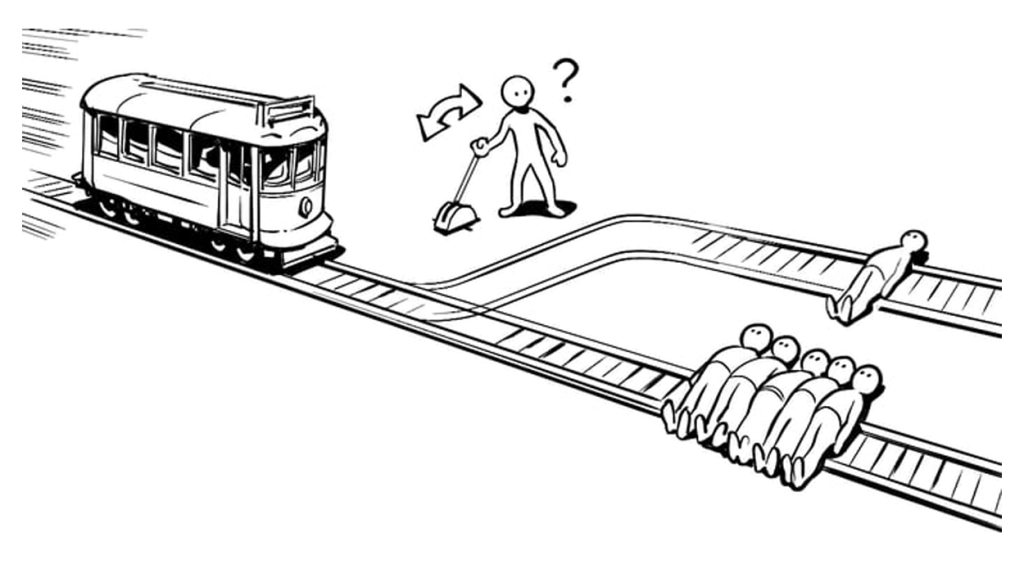
The trolley problem is a series of thought experiments involving ethical dilemmas of whether to sacrifice one person to save a larger number of people. The example in the image above is whether the bystander should let the train run its course and not interact with the situation, or should they pull the lever to save the five people, killing just one instead.
There seems to be no clear answer on the matter since it was introduced in 1967 by Brittish philosopher Philippa Foot in her essay, “The Problem of Abortion and the Doctrine of the Double Effect.”
Whats the ethical decision?
From the viewpoint of moral absolutism, the answer seems to be quite obvious; pull the lever to sacrifice one person in place of five. By interacting with the lever, you end up saving more lives than if you hadn’t interacted in the first place. Ethically speaking, this would be an overall good decision. But there is still an elephant in the room. The bystander has actively decided to kill, which could be considered unethical.
The next question to be asked is, is it ever ethical to take part in murder? The definition of murder is the crime of killing someone deliberately. In the case of the trolley problem, the decision to switch tracks would be a deliberate one. Therefore, the bystander would be committing murder.
Now, if murder is never to be considered ethical, the obvious assumption from earlier to pull the lever becomes that of the complete opposite: Do not pull the lever because it’s unethical to deliberately be involved with killing another man.
Answer
Even from a standpoint of moral absolutism, the answer to the trolley problem is very complex. It leaves a question to the question, can we accept murder as ethical in the case of saving more people than if we decided to do nothing at all?
For me, it’s a yes, murder can infact be ethical. In this case, specifically if the “wanting” to save more people comes from a “good” place and not one of evil. Evil being pulling the lever for the sake of taking part in murder for pleasure. Pulling the lever to save five is the ethical decision.





 Foundry of Reason
Leave a reply to ellised98 Cancel reply